A-Side / B-Side Systems
Spray Foam Chemicals — Open-Cell & Closed-Cell Systems
Professional-grade polyurethane SPF chemical sets engineered for Canadian building codes and climate extremes. Consistent yield, predictable reaction profiles, and winter-grade formulations built for contractors who can't afford an off-ratio spray day.
Open-Cell vs. Closed-Cell: Choosing the Right System
Every job on your schedule falls into one of two chemical categories, and picking the wrong one costs more than a callback — it can mean a failed inspection. Closed-cell spray foam runs roughly 2.0 lb/ft³ density and cures into a rigid, high-R-value structural panel with built-in vapor retarder properties, making it the standard choice for exterior wall assemblies, roofing, rim joists, and any application where an air barrier and structural racking strength both matter. Open-cell foam runs closer to 0.5 lb/ft³, expands far more per set, and delivers excellent sound-deadening and air-sealing performance at a lower installed cost per board foot — the workhorse for interior cavity walls, attics with proper vapor strategy, and sound-control retrofits.
We stock both systems in contractor-grade set quantities so you're not choosing your chemistry based on what happens to be sitting on the shelf. Every set ships with current Safety Data Sheets and lot-traceable documentation for code inspectors and WHMIS compliance records.
Density and yield aren't the only variables worth checking before you bid a job. Closed-cell systems also function as a vapor retarder at roughly 1.5–2 inches of thickness, which changes how you detail wall assemblies compared to open-cell, which typically requires a separate vapor strategy under most Canadian building codes. Open-cell's higher expansion ratio means a single set stretches across dramatically more square footage, which is exactly why it wins on cost-per-board-foot for large interior cavity jobs even though the material itself carries a lower R-value per inch. Matching the right chemistry to the assembly — not just defaulting to whatever you sprayed last week — is where experienced crews separate themselves from callback-prone competitors.
Core Product Lines
Closed-Cell Systems (2.0 lb)
- Density
- 2.0 lbs/ft³
- R-Value
- R-6.8 / inch
- Yield (avg)
- 4,200–4,800 bd. ft.
- Set Size
- 55-gal sets (2 drums)
- Best For
- Exterior walls, roofing, rim joist
Open-Cell Systems (0.5 lb)
- Density
- 0.5 lbs/ft³
- R-Value
- R-3.8 / inch
- Yield (avg)
- 15,000–17,000 bd. ft.
- Set Size
- 55-gal sets (2 drums)
- Best For
- Interior walls, sound deadening, attics
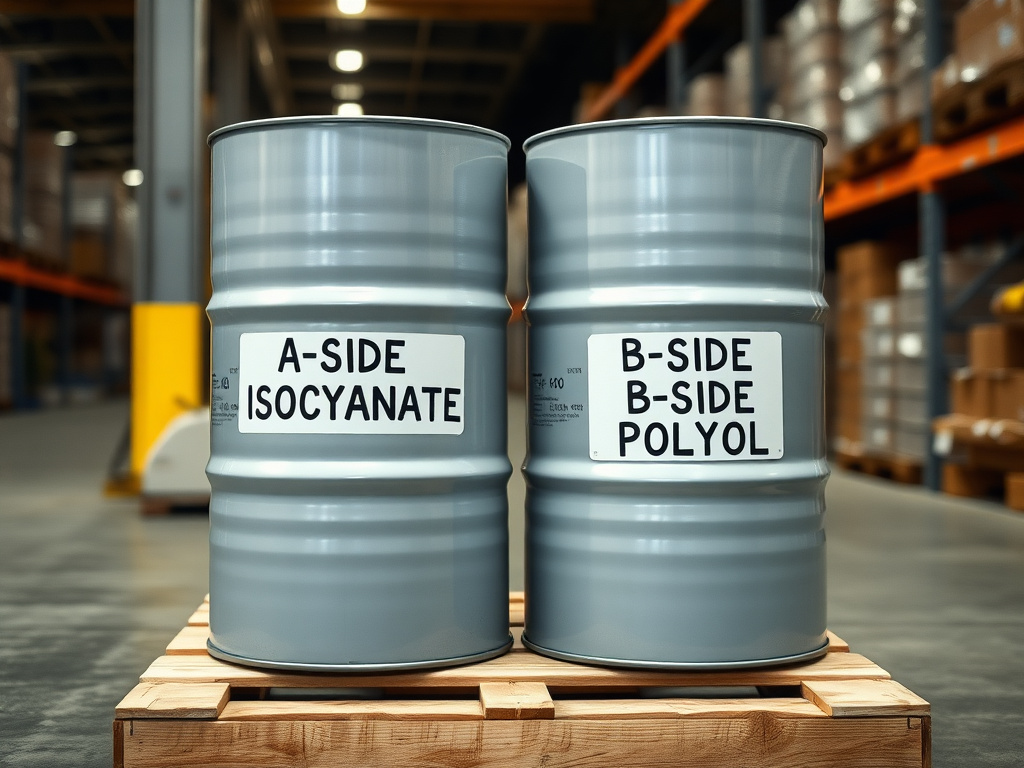
A-Side / B-Side Chemistry Explained
A-Side (ISO)
The isocyanate (MDI) component — highly reactive, initiates the exothermic expansion process the instant it contacts the B-side at your gun tip.
B-Side (Resin/Polyol)
The polyol blend — carries the catalysts, blowing agents, surfactants, and flame retardants that define density, rise time, and final foam properties.
1:1 Ratio by Volume
Both sides are metered 1:1 through a plural-component proportioner at 110–130°F hose temperature. Off-ratio spraying is the #1 cause of adhesion and cure failures.
Low-GWP / HFO Blowing Agents
Our current formulations use HFO blowing agents in place of older HFC chemistry — lower global warming potential while holding yield and R-value performance.
Climate-Adapted Formulations
Standard chemical sets are formulated for mid-range ambient and substrate temperatures. They don't perform the same way on a jobsite in Fort McMurray in January as they do in a heated shop in July. That's why we carry a dedicated winter-grade closed-cell line catalyzed for aggressive expansion even when surface temperatures drop toward -10°C — built specifically for late-season Canadian schedules where waiting for warmer weather isn't an option.
- ✓ Prevents shrinking, ridging, and post-cure peeling in cold substrate conditions
- ✓ Maintains theoretical yield closer to spec when hose and drum temps drop
- ✓ Faster tack-free and through-cure times in cold ambient air
Standard vs. Winter-Grade
Standard-cell chemistry is rated for spraying and substrate conditions down to roughly 10°C. Our Polar-Seal winter-grade closed-cell line extends that working window down to -10°C, which matters most on late fall and early spring installs across the Prairies, Northern Ontario, and Atlantic Canada.
Chemical Line Comparison
A quick reference across our most-ordered lines. Full technical data sheets are available on request for every set we stock.
| Product | Density | Yield (est.) | Primary Application | Climate Rating |
|---|---|---|---|---|
| Ultra-Yield 500 (Closed-Cell) | 2.0 lb/ft³ | 4,600–4,800 bd. ft. | Commercial roofing / exterior | Standard (10°C+) |
| Polar-Seal 200 (Closed-Cell) | 2.0 lb/ft³ | 4,200–4,500 bd. ft. | Winter framing / below-grade | Winter (-10°C+) |
| Standard-Cell 1.0 (Open-Cell) | 0.5 lb/ft³ | 15,000–17,000 bd. ft. | Interior walls / sound deadening | Standard (10°C+) |
Drum Sizes, Sets & Bulk Ordering
Chemicals ship as matched 55-gallon A-side/B-side sets — two drums per set, pre-paired by lot number so ratio performance is predictable from the first pull of the trigger. Single sets work for one-off jobs, but most active contractor accounts order by the pallet (four sets per pallet) to hit better per-set pricing and reduce the number of deliveries hitting the shop each month.
Volume-tiered contractor pricing kicks in on multi-pallet orders, and repeat accounts can lock in pricing ahead of the spring rush through our seasonal pre-buy program — see the contractor pricing program for tier breakpoints and net-terms eligibility. All chemical orders include current SDS documentation and are shipped in temperature-managed freight during winter months to protect viscosity and cure performance in transit.
If you're new to buying chemicals wholesale, plan your first order around your typical two- to three-week job pipeline rather than stocking a full season up front — that keeps working capital tied up in inventory to a minimum while you get a feel for actual set consumption per job type. Once you have a consistent order cadence, moving to pallet quantities and locking pricing through the pre-buy program is where the real per-set savings show up.
Chemical FAQs
What's the shelf life of open-cell vs. closed-cell spray foam chemicals?+
Unopened drums stored within the recommended temperature range typically hold spec for 6 months from the manufacture date, printed on each drum. Closed-cell B-side (resin) is more sensitive to temperature swings than open-cell and should be rotated first-in, first-out.
How should I store A-side and B-side drums over a Canadian winter?+
Keep drums in a heated storage area between 15–32°C. Never let drums freeze — freeze/thaw cycling permanently changes viscosity and off-ratio risk goes up. If drums do get cold in transit, allow at least 24–48 hours at room temperature before spraying.
Which chemical formulation is best for cold-weather spraying in Canada?+
Our Polar-Seal winter-grade closed-cell line is catalyzed for substrate and ambient temperatures down to -10°C. Standard-cell chemistry is rated to roughly 10°C and isn't recommended for late-season or northern jobsite conditions.
What's the difference between HFO and older blowing-agent chemical systems?+
HFO (hydrofluoroolefin) blowing agents have a dramatically lower global warming potential than legacy HFC blowing agents while holding comparable yield and R-value performance. All of our current-generation sets use HFO chemistry.
Can open-cell and closed-cell chemicals from different manufacturers be mixed?+
No. A-side and B-side components are formulated as matched pairs — mixing A-side from one manufacturer with B-side from another (or across different product lines from the same manufacturer) produces unpredictable ratio and cure results. Always keep sets paired by lot.
Is there a minimum order quantity for chemical sets?+
Single sets are available for smaller jobs, but contractor pricing tiers start at pallet quantities (four sets). Active trade accounts can mix chemical orders with parts and PPE on the same freight run to hit free-freight thresholds faster.
Ready to Order Chemicals?
Open a contractor account for volume pricing, net terms, and priority access to winter-grade formulations before the season turns.